

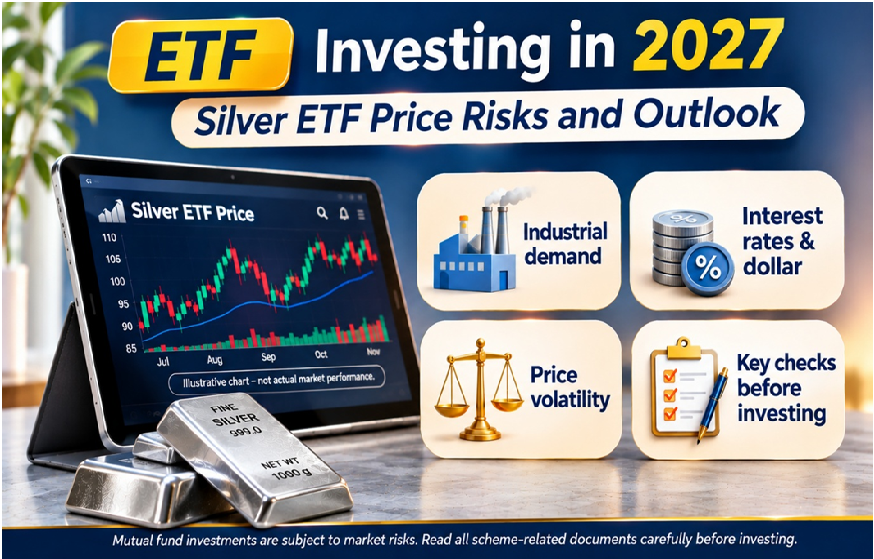
Silver has seen significant investor interest in 2026, but its erratic price movements have also raised concerns. Many investors are left wondering if silver is still worth considering as they plan their investments for 2027 due to abrupt falls following periods of significant increases. Investors can take part in silver price fluctuations without purchasing or storing actual silver by using an ETF (Exchange Traded Fund). But convenience does not reduce investment risk. The price of a silver ETF is impacted by several factors, including industrial demand, world economic conditions, interest rates and currency fluctuations. Being aware of these factors can help investors decide whether silver is a worthy portfolio addition or simply a case of buying in because prices have fallen.
Why Is the Silver ETF Price So Volatile?
Gold is purchased to preserve wealth and as an investment, but silver also has a significant industrial use. Silver is used in solar panels, electronics, electrical equipment, and various manufacturing applications. This trend means two major sources of demand silver: investors buying it as a precious metal and businesses buying it for industrial use.As industry grows, the demand for silver may increase. If economic growth slows, manufacturers could cut back on purchases, putting pressure on prices.
Several developments have contributed to silver’s price fluctuations during 2026.
- Industrial Demand Change
Silver is important in solar energy and electronics. But manufacturers are also finding ways to use less silver in some products. This means that growing demand for solar panels does not mean growing demand for silver to the same extent.
- Dollar Movements and U.S. Interest Rates
Internationally, silver is traded in U.S. dollars. A strong dollar makes silver more expensive to those using other currencies. Higher interest rates can also make interest-paying investments more appealing than precious metals. Both can influence investor demand and the silver ETF price.
- Investor Purchase and Sales
Silver prices can move dramatically when investors are buying or selling fast. Some investors, for example, may sell after a strong rally to take profits. Others may sell if they anticipate further losses. Such moves can cause short-term volatility even when industrial demand is relatively stable.
Could Silver ETF Prices Recover in 2027?
There is room for a recovery but you also have to acknowledge that the price of silver may stay weak or go lower. The direction will depend on a number of economic and market developments. “The 2026 outlook from the Silver Institute shows persistent pressure on some segments of silver demand, even as global supply constraints weigh on the market. This creates an interesting situation where silver can be in limited supply and not necessarily deliver immediate gains in price.
Possible Silver ETF Price Scenarios for 2027
| Market condition | Possible effect on silver prices | What investors should understand |
| Global manufacturing activity improves | Industrial demand may strengthen | Recovery is possible but not guaranteed |
| US dollar and interest rates remain high | Silver may face selling pressure | Further corrections are possible |
| Solar and electronics demand strengthens | Could support silver consumption | Technology changes may reduce silver use per product |
| Economic growth slows | Industrial demand may weaken | Silver may experience greater volatility |
| Supply remains tight while demand improves | Prices could receive support | Supply shortages do not guarantee higher returns |
These scenarios are illustrative and should not be treated as price predictions.
The important lesson is that silver’s future performance cannot be judged by its recent price correction alone.
How Does a Silver ETF Work During Market Corrections?
A Silver ETF is a mutual fund scheme that aims to replicate the domestic prices of silver, net of expenses and tracking differences. Its units are traded on stock exchanges like shares. Suppose an investor buys 100 units of Silver ETF at Rs.100. The total investment will be ₹10,000 excluding brokerage and other charges applicable on the transaction.
Now consider the following example.
| Silver ETF unit price | Investment value | Gain or loss |
| ₹100 (Purchase price) | ₹10,000 | — |
| ₹90 (10% decline) | ₹9,000 | −₹1,000 |
| ₹80 (20% decline) | ₹8,000 | −₹2,000 |
| ₹110 (10% increase) | ₹11,000 | +₹1,000 |
Illustrative calculation only. Actual ETF returns depend on market prices, expenses and transaction costs.
If an investment decreases by 20%, it must increase by 25% to return to its original value. This is why buying an ETF just because its price has fallen significantly can be risky.
What Should Investors Check Before Choosing a Silver ETF?
It does not matter if you are an investor who has just started investing or if you have been investing in ETFs for quite some time, understand a few practical factors mentioned belowto help make better decisions.
- Expense Ratio
Operating expenses exist for every ETF. The expense ratio is the annual cost of operating the fund and is reflected in its value. Lower expenses can help to narrow the gap between the fund’s returns and its underlying benchmark over time. But investors shouldn’t choose an ETF based on expenses alone.
- Tracking Difference
The silver ETF is meant to follow the silver price in the country, though it may not be exactly same. For example, if the benchmark rises 8%, and the ETF returns 7.5%, the difference is 0.5 percentage points. This may be due to expenses and other operational factors. In general, the smaller and more consistent the tracking difference, the better the ETF is tracking its benchmark.
- Trading Liquidity
The liquidity refers to how easily the ETF trades on the exchange. There are ETFs that are more actively traded than other ETFs. Thin trading means that investors could have to pay a higher price for a purchase or take a lower price for a sale than they might otherwise expect. Investors can examine the trading volumes and the spread between the buy and sell prices to get a sense of these costs.
- Market Price Versus NAV
The Net Asset Value (NAV) of an ETF is the value of its underlying investments divided by the number of units. But the price its units trade at on an exchange can be a bit higher or lower. For example, an ETF with an underlying value of ₹100 can trade at ₹102 due to market demand. A premium purchase is when you pay more than the underlying value and this can affect returns if the premium disappears.
- Existing Portfolio Exposure
Investors should consider what percentage of their total savings is already in precious metals. By holding gold, silver and several commodity ETFs you may be increasing your exposure to the same market risks. Silver can diversify but over-investing in one commodity can leave a portfolio more vulnerable to price movements.
Should Investors Buy, Hold or Wait?
There’s no one-size-fits-all answer.” An investor trying to achieve long-term financial objectives may view silver differently than one seeking to make a quick profit.
Here’s a checklist before you invest:
- Know your reason for investing: Understand why you want silver in your portfolio.
- Rethink your time horizon: Don’t rely on volatile investments for money you’ll need soon enough.
- Review existing investments: Evaluate your total exposure to gold, silver and other commodities.
- Compare ETF expenses: Consider the costs, tracking error and trading liquidity.
- Stagger purchases: Purchasing in lesser quantities over time might lessen the impact of a single purchase price, although losses may still occur.
- Have emergency savings: Do not invest money that you need for basic expenses.
- Periodically review your decisions: When your financial circumstances change, reevaluate your investments.
Existing investors in Silver ETFs need not sell simply because the prices have come down. Similarly, buying more units just to recover past losses may lead to emotional decision-making.
Conclusion: Look Beyond the Silver ETF Price Correction
Silver’s recent volatility is a timely reminder of the importance of knowing an asset before you invest in it. Interest rates, currency fluctuations, industrial demand and global economic conditions may continue to affect the price of the silver ETF throughout 2027.A correction can make prices look attractive, but that doesn’t mean silver is undervalued and ready to rally. Investorsshould consider their financial objectives, risk tolerance, investment costs and current portfolio allocation instead of trying to predict the lowest price. Better to take a considered view on ETF investing than to react to every market movement.
Frequently Asked Questions
- Is a Silver ETF suitable for beginners?
Silver ETF presents a good option for investing in silver without having to store any physical metal. It is, however, important to note that the price of silver can be very volatile. And ETFs carry marketrisks.
- Can the silver ETF price fall further in 2027?
Yes. Prices can fall further with reduction in industrial demand, increased US dollar strength, or lower exposure to silver. But with increased demand and reduced supply will provide a boost for silver prices. Neither condition is a certainty.
- Is a Silver ETF better than physical silver?
A silver ETF takes away the concern of physical storage and purity issues, while physical silver means you own it outright Before choosing, investors should compare expenses, liquidity, taxes, storage requirements and their investment objectives.
- What is the difference between Silver ETF price and NAV?
The silver ETF price is the price at which the units are sold or bought at an exchange. The NAV is the intrinsic value of the underlying assets held by the fund per unit. The trading price may either be above or below NAV depending on market conditions.
- Should investors buy more Silver ETF units during a correction?
Buying more on a correction may lower average cost of purchase, but it also increases exposure to silver. Investors should consider their financial objectives, existing holdings and ability to bear additional losses before investing.
Disclaimer
Mutual fund investments are subject to market risks. Read all scheme-related documents carefully before investing. Silver ETFs do not guarantee returns or capital protection.